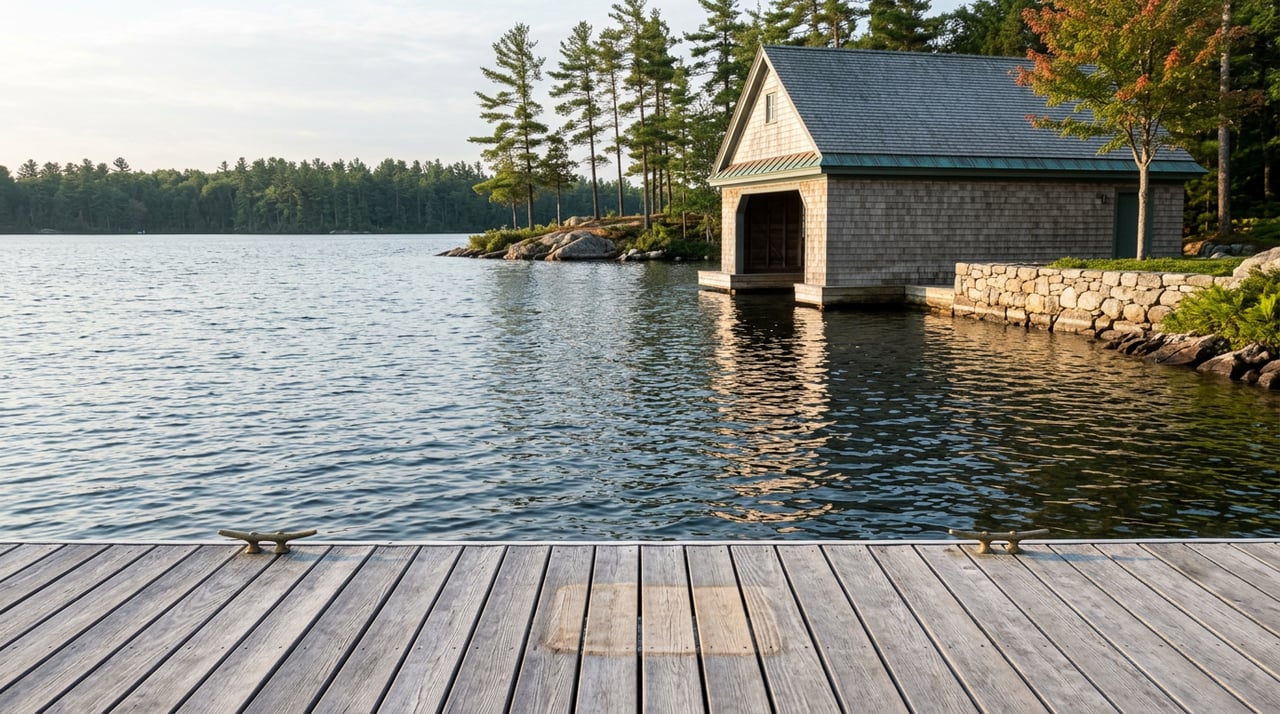
In 2018, a couple who owned property on Lake Winnipesaukee built a deck and a stairway leading down to the water. It seemed like the kind of project that happens on lakes every summer: an outdoor improvement tied to a home the family already owned, on land they already held title to. Nobody was digging a new foundation or clearing acres of shoreline. It was a deck and some steps.
In May of 2025, the New Hampshire Supreme Court disagreed with how simple that project actually was. The structure extended out over the surface of the lake itself, past the shoreline and over water the state holds in trust for the public. The court's order in that case, filed under Appeal of Robert Newcomb, confirmed that a structure doesn't need to touch the lakebed to fall under the state's prohibition on dwellings over water. Even a deck. Even stairs. The homeowners argued they owned the submerged land beneath their addition. The court held that ownership claim didn't matter, because the statute protecting public waters controls regardless of what a landowner believes their deed conveys beneath the waterline.
That ruling sits in the middle of a longer run of changes to how New Hampshire enforces shoreline violations, changes that started before the case was decided and kept going after it. Together, they explain why a project like the Newcombs' carries more exposure today than it would have a few years ago, and why anyone buying, selling, or improving waterfront property on Winnipesaukee should treat permit paperwork as part of the deal itself, not a formality to sort out later.
A Bar That Dropped, Then a Second Name Added
The first change came before the Newcomb order was even issued. House Bill 1103, passed in 2024, took effect January 1, 2025, and it rewrote how the state proves a shoreland violation. Under the old language, the state had to show that a violation had damaged the waterbody and that the owner failed to make a good-faith effort at restoration after being notified. HB 1103 struck that language. What's left is simpler and easier to enforce: a violation that isn't restored within a year of notice is enough on its own, with no separate proof of environmental harm required.
The second change came about eight months ago, roughly a year after the first. Senate Bill 299, effective January 1, 2026, does something New Hampshire's shoreland law had never done before. It lets the state or a municipality pursue the contractor directly, not just the property owner, when work violates the Shoreland Water Quality Protection Act. A superior court can levy a civil penalty of up to $5,000 per violation against the person who supervised or performed the work, and the commissioner can separately impose an administrative fine of up to $5,000 after notice and a hearing. Before this law, a homeowner who hired the wrong crew absorbed the consequences alone.
Read in sequence, the shift looks like this:
| Change | Took effect | What it means |
|---|---|---|
| Proof-of-damage requirement removed | January 1, 2025 | The state can act on an unrestored violation after a year's notice, without separately proving harm to the water |
| Contractor liability added | January 1, 2026 | The contractor who supervised or performed the work can be fined directly, alongside the property owner |
The Newcomb order landed in the gap between the two, in May 2025, after the proof-of-damage bar had already come down and before contractors had any personal stake in the outcome. None of this changes the underlying rule that most work within 250 feet of Lake Winnipesaukee's shoreline, a boundary set by the Shoreland Water Quality Protection Act, requires a permit. What changed is how much room there was to quietly skip that step, and, as of this year, who else besides the owner can be held to account for it.
The Part That Actually Matters for a Transaction
Here's the piece that's easy to miss if you only read the statute. Before this year, a contractor building a dock, a deck, or a set of shoreline stairs had very little personal stake in whether the homeowner had pulled the right permit. If the job went sideways, the homeowner's name was the one on the violation. That meant the person best positioned to ask the awkward question early, before the first post went into the ground, often had no particular reason to ask it.
Now the contractor's name can end up on the same notice as the owner's. A builder who wants to keep working on this lake has a direct reason to confirm permit status before touching a shoreline project, not after a neighbor calls it in. That's the real shift. It moves the moment of scrutiny earlier in the process, from something that surfaced occasionally during enforcement to something a careful contractor now checks as a matter of course. Firms that do this work regularly around the lake, from marine construction outfits to island-focused general contractors, have every incentive to build that question into their intake process going forward.
For buyers and sellers, that earlier scrutiny is good news in theory and a real point of friction in practice, because it means the permit history of an existing dock, deck, or stairway is no longer a background detail. It's part of what a contractor, a title search, or a diligent buyer's attorney is now more likely to ask about directly.
If You're Buying a Home With an Existing Dock or Shoreline Structure
A few habits are worth building into the process before you're under contract, not after:
- Ask for the permit history on any dock, deck, patio, or stairway within roughly 250 feet of the water, not just the dock itself. The Newcomb case is a reminder that non-dock structures near the shoreline fall under scrutiny too.
- If a structure is described as grandfathered, ask for the documentation that supports it. Grandfathered status typically depends on old photographs, plans, or dated permits, not on how long something has simply been standing.
- Find out whether any part of the structure extends over the water's surface rather than stopping at the shoreline. That distinction was the entire basis of the Newcomb ruling.
- If you're planning to repair or expand an existing structure after closing, confirm with a shoreland-savvy contractor what triggers a new permit review versus what counts as routine maintenance. The line between the two is narrower than most buyers assume.
If You're Selling an Older Camp on the Lake
Many of the camps and cottages that have been in Winnipesaukee families for decades picked up additions over the years the way most lived-in homes do: a deck rebuilt a little wider, a stairway replaced in a slightly different spot, a patio poured closer to the water than the original footprint. None of it may have been reviewed formally at the time, and for a long time the practical risk of that was low.
That comfort depends less on documentation now and more on whether a violation exists at all, since the state no longer has to prove the change caused measurable harm. If you're preparing to list an older waterfront property, it's worth pulling whatever permit records exist for shoreline structures before a buyer's attorney asks for them, and deciding with a professional whether anything needs addressing before the property goes on the market or should simply be disclosed as part of the process.
A Few Questions Worth Asking Early
Does this only apply to islands, or mainland shorefront too? The 250-foot protected shoreland boundary applies lakewide, to any property along Winnipesaukee's shoreline in Alton, Gilford, Laconia, Meredith, Center Harbor, Wolfeboro, Moultonborough, and Tuftonboro, not just to island parcels.
If my dock predates current rules, am I automatically covered? Grandfathering can still apply, but it depends on being able to document the original date and configuration. Changing the size, location, or footprint of a grandfathered structure can forfeit that status, which is part of why permit paperwork matters more than memory.
Who actually enforces this, the town or the state? The New Hampshire Department of Environmental Services handles shoreland enforcement statewide. Civil penalties against contractors go through the superior court on petition from the attorney general or the municipality where the violation occurred.
None of this is legal advice, and any specific question about a permit, a grandfathered structure, or a pending sale is worth bringing to an attorney or a shoreland permitting professional who can look at the actual paperwork.
What it does mean, for anyone buying or selling on this lake this year, is that the conversation about docks and shoreline structures has moved earlier in the timeline. It used to be something you dealt with if a problem came up. Increasingly, it's something you deal with before you make an offer or before you list.
If you're weighing a purchase on Winnipesaukee, or preparing to sell a property that's been in the family for a while, Becky Fuller has spent more than two decades working through exactly this kind of shoreline detail with buyers and sellers across the lake. Let's Connect before you're mid-transaction and these questions become urgent instead of routine.