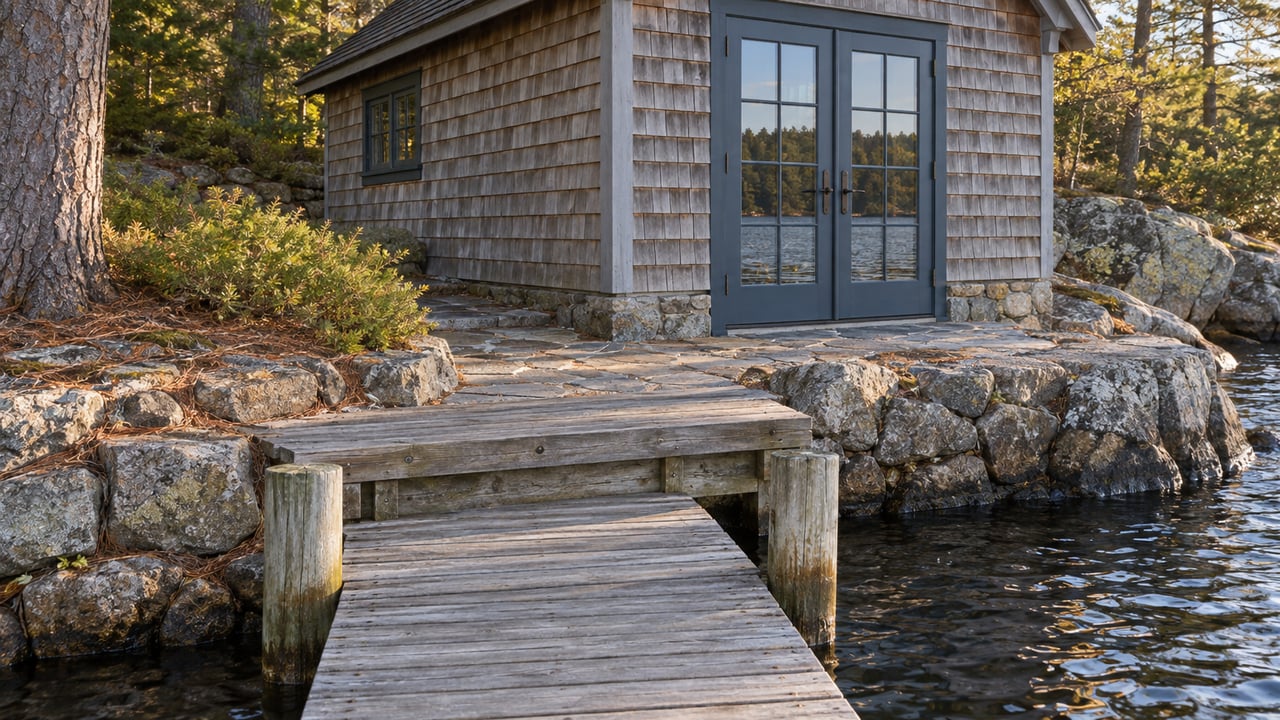
Walk the shoreline in late September and you will see the split before anyone explains it to you. Some docks are already gone, hauled up onto the lawn in sections or stacked in a boathouse, leaving a bare strip of shoreline and a mooring ball bobbing where a walkway used to be. Others sit exactly where they sat in July, pilings driven into the lake bottom, decking weathered gray, going nowhere for the winter.
Buyers touring waterfront listings this time of year tend to read that difference as taste. It isn't. It is a regulatory line drawn by the New Hampshire Department of Environmental Services, and which side of it a property sits on affects what the dock cost to build, what it costs every single year afterward, and whether the paperwork behind it will hold up when the property changes hands.
Two Categories, Three Levels of Paperwork
According to NH LAKES, New Hampshire treats every dock on Lake Winnipesaukee as one of two legal types, and the type determines how much scrutiny the state applies before anyone can build.
A seasonal dock is removable by design. To qualify for the state's simplified process, it has to come out of the water for at least five months of the non-boating season, measure no more than six feet wide by 40 feet long, and sit on a parcel with at least 75 feet of shoreline frontage.
A permanent dock skips the seasonal path entirely. These are the pile-supported and crib-supported structures that stay in the lake through ice-in and ice-out, and the state only allows them on lakes larger than 1,000 acres, which covers Winnipesaukee. Getting one approved requires a Standard Dredge and Fill Wetlands Permit application, and the New Hampshire Department of Environmental Services says that, as of July 1, 2025, the application fee for that tier rose from $400 to $600.
None of this is about a dock's age or how it looks from a passing boat. It is about which application the state has on file for it.
The One Lake in New Hampshire Where the Rules Change
Winnipesaukee's roughly 44,586 acres make it the only lake in New Hampshire larger than 10,000 acres, and that threshold changes the legal dimensions of a boat slip. On every other lake in the state, a boat slip is defined as 20 feet long, 6 feet wide, and 3 feet deep. On Winnipesaukee, that same slip grows to 25 feet long, 8 feet wide, and 3 feet deep.
A buyer cross-shopping a cottage on Winnipesaukee against one on Squam Lake or Lake Winnisquam is not comparing docks built to the same legal footprint. The larger lake carries a larger legal allowance, and that difference shows up in what a seller can build, what a buyer can add later, and how a dock's existing dimensions compare to what current rules would permit from scratch.
What Actually Earns a Dock Permanent Status
The state does not grant permanent status because an owner prefers year-round pilings over spring assembly. It grants permanent status when an applicant can show that a seasonal dock would not be safe or workable at that specific location. The Wetlands Bureau's own guidance names the qualifying conditions directly: wave exposure severe enough to threaten a removable structure, islands reachable only by boat, and commercial or public use.
That second condition is the one that matters most for anyone considering an island property on Winnipesaukee. Boat-only access is not a lifestyle detail the state shrugs off. It is one of the three named justifications for building a dock that never comes out of the water. An island camp with no seasonal alternative for reaching it has a stronger, more legible case for a permanent dock than a mainland cottage in a sheltered cove where a seasonal dock would work just fine.
The reverse also holds. A permanent dock on a calm, protected shoreline with easy road access has less obvious justification on file, and that gap is exactly the kind of thing a buyer's attorney or a title search can surface late in a transaction, after an offer is already in and a closing date is already set.
The Ritual Underneath the Rule
The five-month removal requirement is not just a compliance checkbox. It is a physical job that happens on a calendar every fall, and the businesses that do it are some of the most established names on the lake.
Fay's Boat Yard in Gilford has served Winnipesaukee boaters since 1944, running haul-outs and winterization alongside its marine repair work. West Alton Marina, family owned for 64 years, handles seasonal launch and haul-out logistics at the southern end of the lake. Winnipesaukee Island Services and Winnipesaukee Builders both specialize specifically in dock installation and removal, sending crews out each fall to disassemble sectional and crank-out docks before ice threatens them.
Mike Metcalfe, who owns Winnipesaukee Island Services, has described the fall removal process as one that goes smoother with a plan set before the first section comes out of the water, so hardware gets labeled and stored in an order that makes spring reassembly straightforward rather than a scramble. That labor repeats every year for a seasonal dock owner. It never happens for a permanent one, which is part of why permanent structures cost more to build up front and less to maintain year to year, a tradeoff that only makes financial sense if the underlying permit is sound.
What a Buyer Should Actually Check
New Hampshire gives buyers a way to check this before closing rather than after. The Wetlands Bureau maintains a public permit query tool where anyone can search a property's dock permit history by location. It won't answer every question, but it will show whether a permanent structure has documentation behind it or whether the file is thin.
The New Hampshire Department of Environmental Services has also created a voluntary registration process specifically for existing docks, separate from applying for a new permit, and it exists in part to make property transfers cleaner. An owner who registers an existing dock this way gives the next buyer a documented compliance record instead of a structure whose history has to be pieced together during due diligence.
A few questions worth asking before writing an offer on a Winnipesaukee waterfront property:
- Is the dock seasonal or permanent, and does the listing or seller disclosure say which
- If permanent, what documented condition, wave exposure, boat-only access, or commercial use, supported that approval
- Has the dock been voluntarily registered with the Wetlands Bureau, or does its file only show the original construction permit
- If the property is an island, does the existing dock reflect the boat-only access justification, or was it built under an older, less specific standard
The Laconia Daily Sun reports that mooring permits run on a separate track entirely. Those are handled by the state's Marine Patrol Unit rather than the Wetlands Bureau, and they use their own version of a demonstrated-need standard, one built around whether a property has any other way to dock a boat. A buyer who confuses a mooring permit with a dock permit is looking at the wrong file.
A Few Questions Worth Asking Early
Can a seasonal dock be converted to permanent after purchase? Only if the new owner can document one of the same conditions the state requires for any permanent approval, wave exposure, boat-only access, or commercial and public use. Ownership changing hands does not change what the shoreline itself can justify.
What should a buyer confirm about a permanent dock? The physical structure stays, but a buyer should confirm what documentation exists before closing rather than after.
Can a dock's age tell you whether its permanent status is sound? A dock's age alone does not settle that; the permit record is worth checking.
Becky Fuller has spent summers on Bear Island long enough to know that a dock tells you almost nothing about a property until you know which permit is behind it. If you're comparing waterfront or island listings on Lake Winnipesaukee and want a straight read on what a dock's status actually means for cost, upkeep, and resale, Becky Fuller is glad to walk through it with you.
This article is general information, not legal, tax or financial advice. Consult a qualified professional about your situation.